A rounded pale ash frame and a warm apricot wall let a room full of blue breathe.A digital framing study made in Wallside.
THE ARTWORK
Little Girl in a Blue Armchair
Mary Cassatt
1878
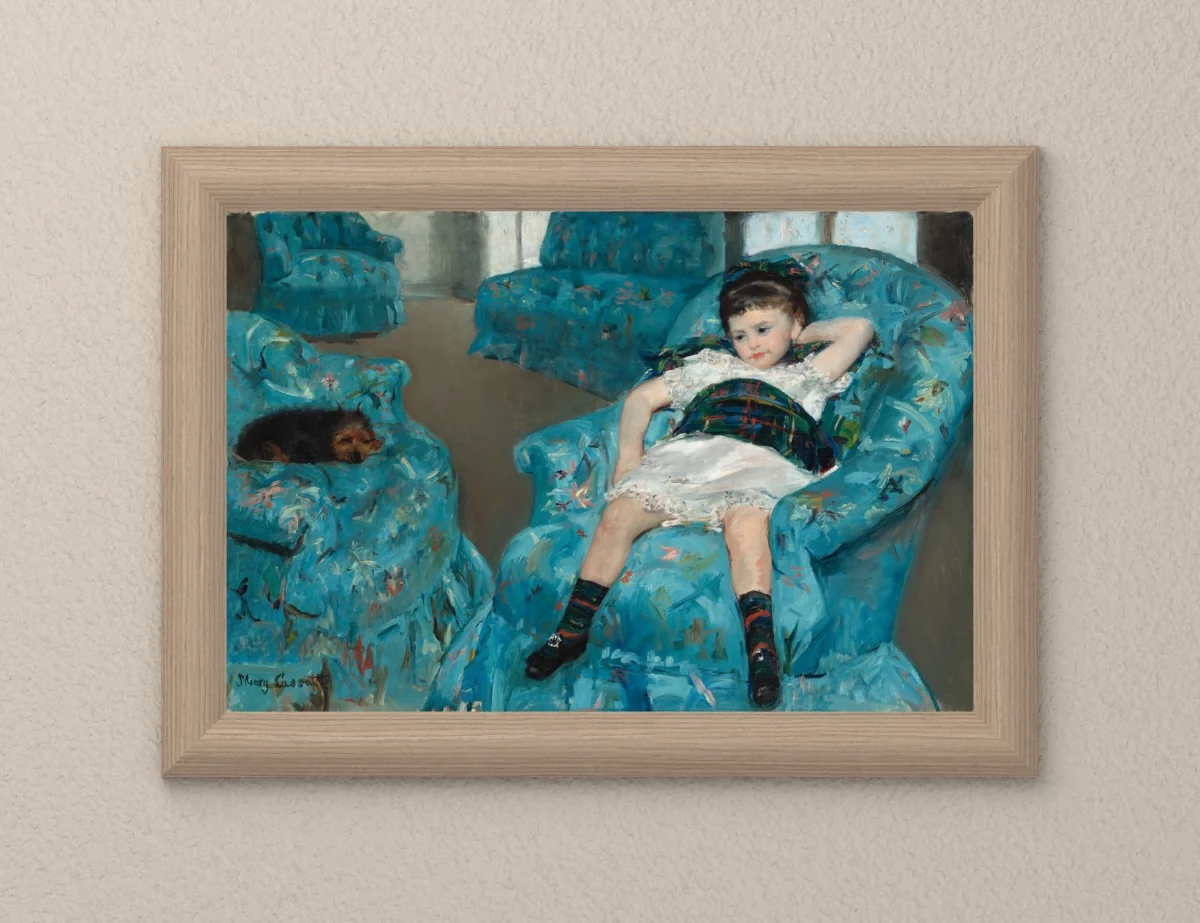
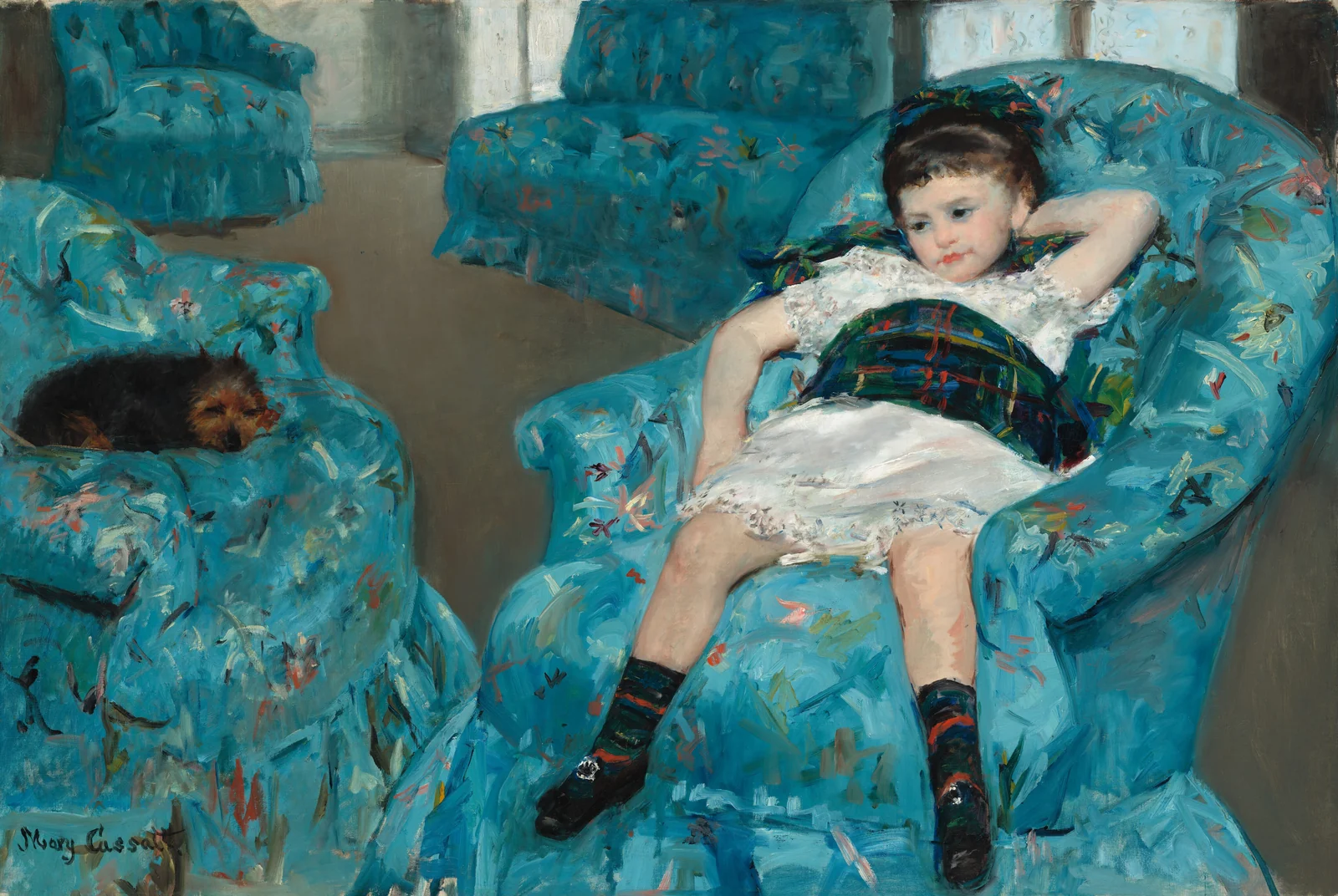
A little girl sprawls in a big armchair, hands behind her head, mouth pursed, utterly bored. In 1878 the painting was rejected by the American section of the Paris World's Fair. Cassatt later wrote that she was furious — all the more because Degas had worked on it himself.
Behind the artwork
The National Gallery of Art says the girl was the daughter of friends of Degas. Cassatt didn't paint her as a well-behaved little adult; she caught the least photogenic moment — tired of playing, just told off, or simply bored — the whole body flopped into the chair.
The dog asleep on the opposite chair is Baptiste, Cassatt's own Brussels griffon, which Degas helped her find.
Degas's involvement went further. Around 1903 Cassatt wrote to the dealer Ambroise Vollard that Degas thought the child was good, advised her on the background, and even worked on it himself. The museum believes the corner of the room at the back is probably his, giving the composition more movement; later cleaning and infrared photography supported this.
She sent the painting to the American section of the 1878 Exposition Universelle, and it was turned down. As quoted by her biographer, Cassatt complained that the jury had only three members, one of them a pharmacist. Our view: what the jury missed is exactly what moves us today. It doesn't prettify a child; it honestly paints a small person's bad mood.
A frame for this work
A bored child the jury turned away
The canvas is nearly filled with blue upholstery, so the frame needs to be light and warm: a rounded pale ash frame like nursery furniture, and a warm apricot wall that complements the turquoise and keeps the painting from feeling cold.
A rounded pale ash frame and a warm apricot wall let a room full of blue breathe.
About the Wallside app