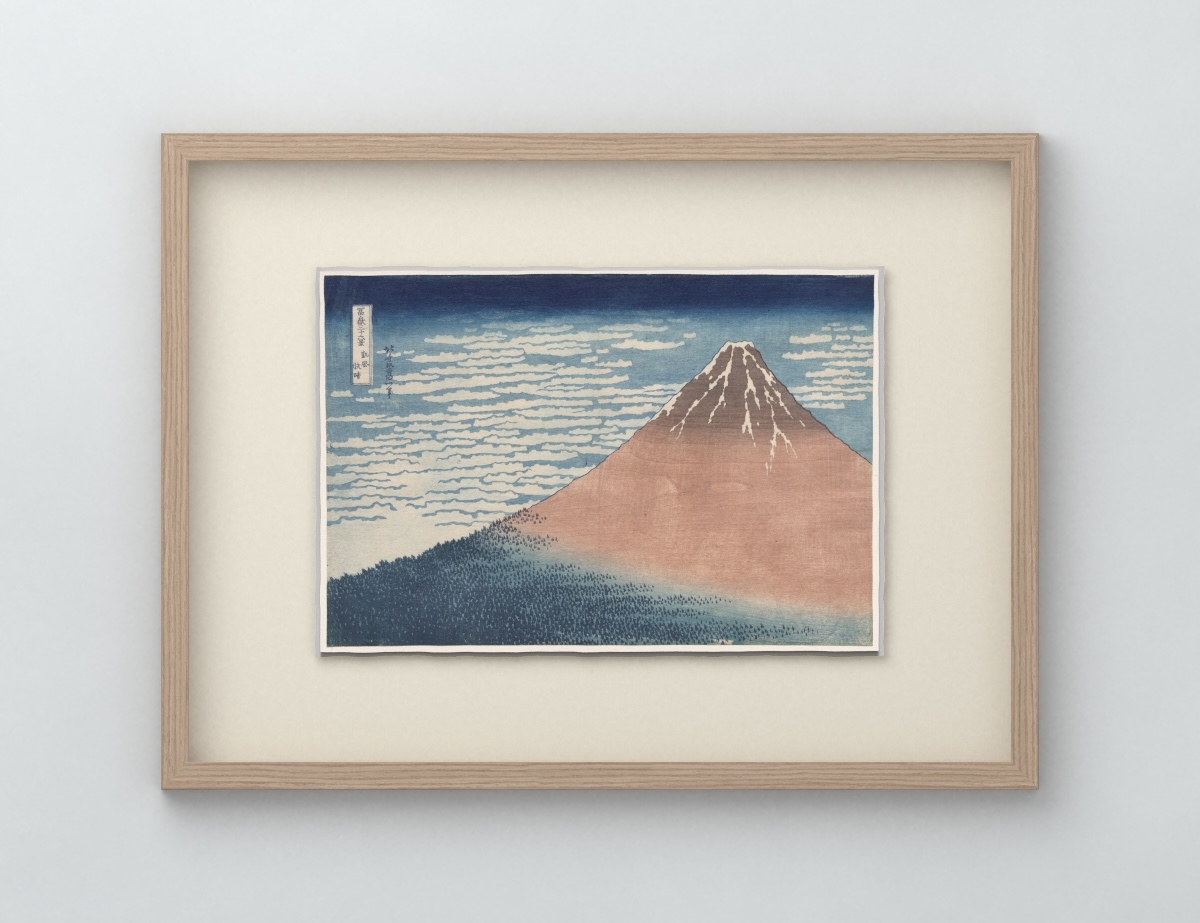
A slim ash frame and a float mount on kozo paper keep the whole sheet and its margins in view.A digital framing study made in Wallside.
THE ARTWORK
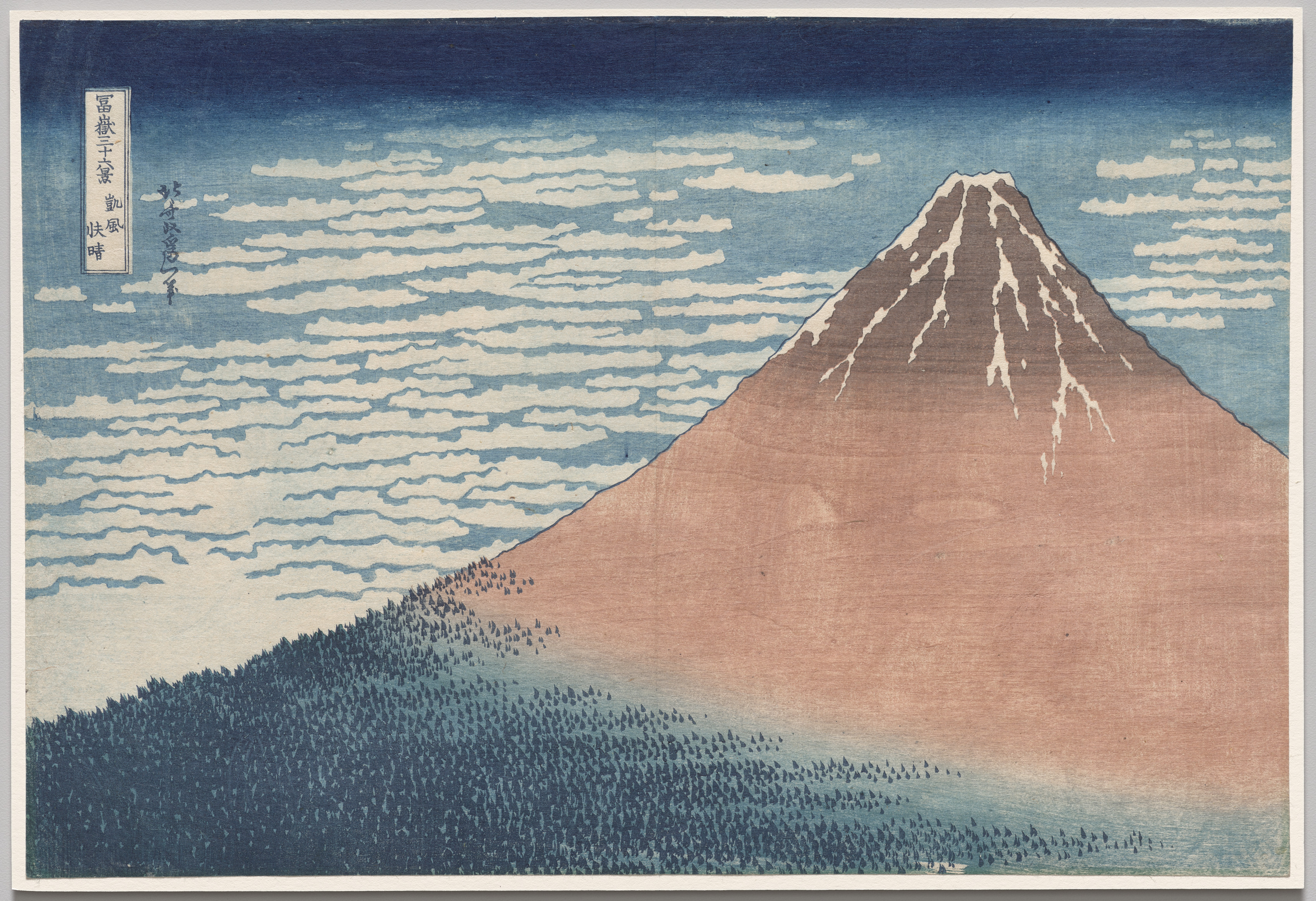
South Wind, Clear Sky, from Thirty-Six Views of Mount Fuji
Katsushika Hokusai
early 1830s
One mountain, three main colours, almost no detail — this is the print people call 'Red Fuji'. Hokusai was about seventy when he made it; the landscape series that made him world-famous arrived in the last two decades of his life.
Behind the artwork
Born in 1760, Hokusai produced Thirty-Six Views of Mount Fuji between 1829 and 1833. The Victoria and Albert Museum calls it the first series made entirely of large-format landscape prints. Before it, ukiyo-e belonged to beauties, actors and people at famous sights; Hokusai made a mountain the protagonist.
The blue was new as well. The series makes plentiful use of Prussian blue, a pigment only recently introduced to Japan, expensive and rare. The prints were so popular that, despite the title, ten more designs were added — forty-six in all.
South Wind, Clear Sky is the simplest of them: a southern breeze, a clear day between late summer and early autumn, the mountain turning red in the light. The Cleveland Museum of Art points out a detail: during printing, the natural grain of the cherry-wood block was pressed into the paper along with the red.
What we find remarkable is the subtraction. Hokusai had drawn thousands of people and stories; at seventy he dared to leave only a mountain, a band of cloud and a diagonal.
Watch the short
A frame for this work
At seventy, a red mountain
The margins of a print are part of the work, so the sheet is float-mounted rather than covered at the edges; the slim ash frame and pale blue-grey limewash wall step back and let the red and blue speak.
A slim ash frame and a float mount on kozo paper keep the whole sheet and its margins in view.
About the Wallside app