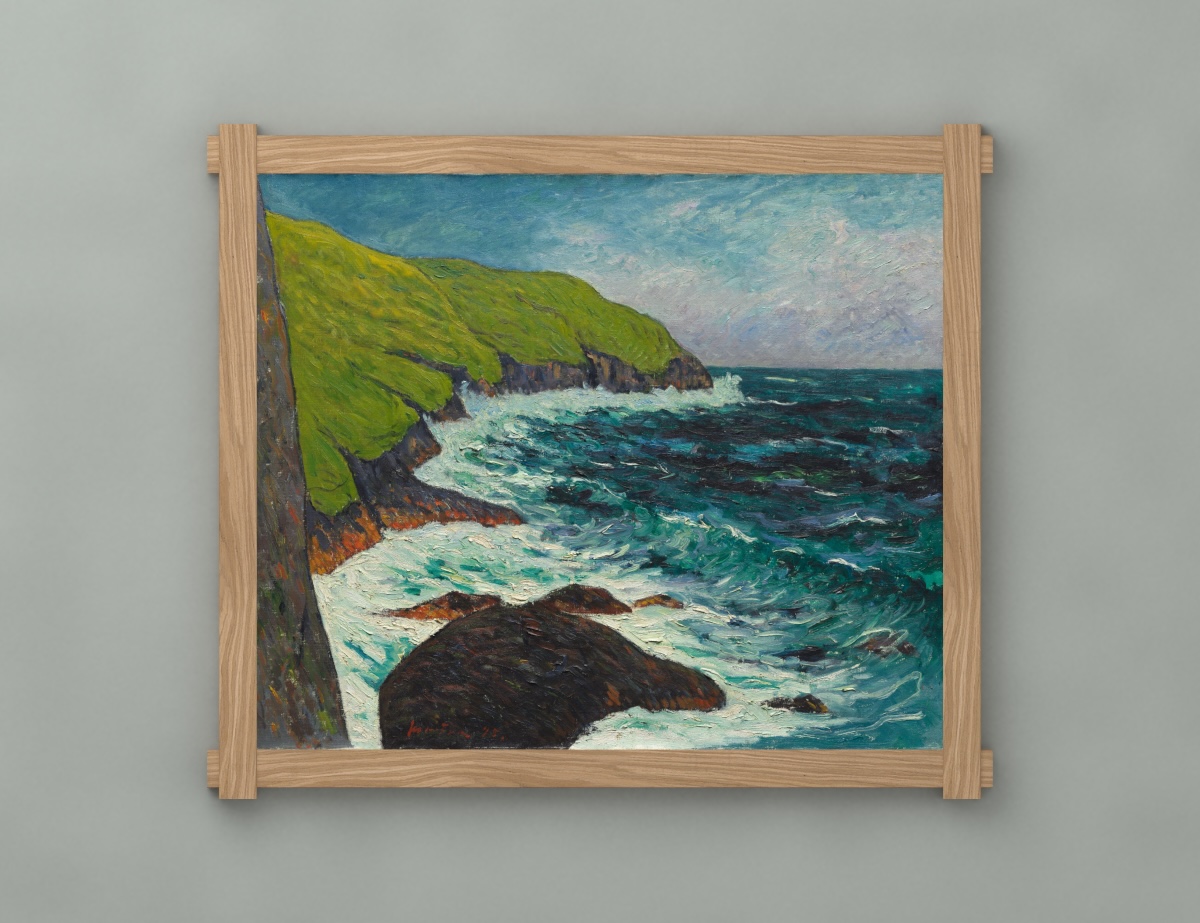
An oak frame and a quiet green-gray wall hold a restless coast.A digital framing study made in Wallside.
THE ARTWORK
The Cliffs at Beg-ar-Fry, Saint-Jean-du-Doigt
Maxime Maufra
1895
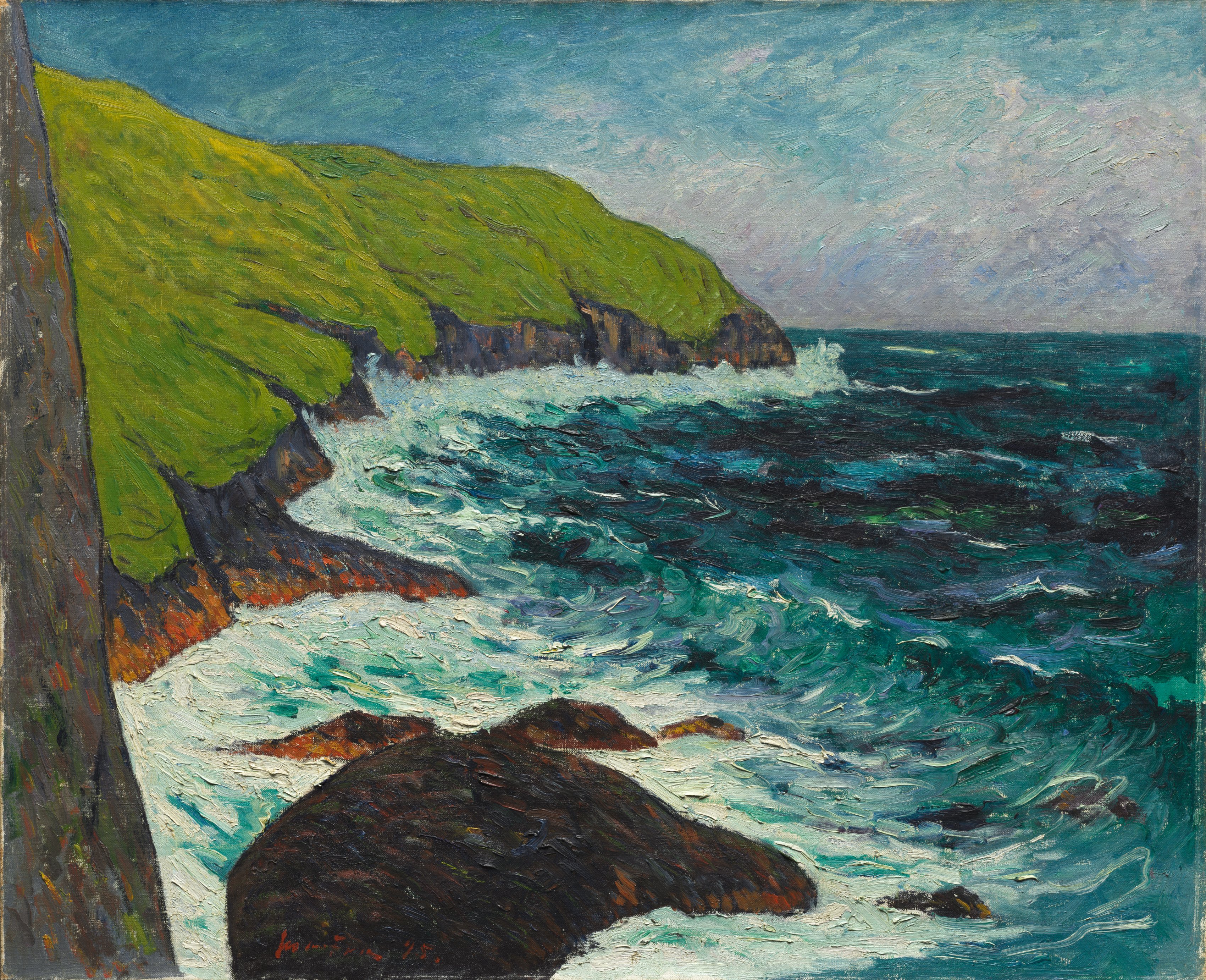
A green headland cuts across a restless turquoise sea. Maufra makes the coast feel close enough to touch: thick white strokes gather into foam, while a sheer rock face holds the left edge of the view.
Discover the story ↓Behind the artwork
Painted in 1895, this view of the Breton coast belongs to Maxime Maufra’s long engagement with the landscapes and shores of northwestern France. The Cleveland Museum of Art records his encounter with Paul Gauguin at Pont-Aven in 1890 and connects the painting’s broad, strongly colored shapes to that influence. The work is oil on fabric, measuring 60 × 73.3 cm without its frame.
The green slope descends in a long diagonal toward the distant water. Along its foot, dark rock alternates with white surf; the headland’s calm outline meets the broken rhythm of the waves. The horizon appears only on the right, so the coast occupies much of the view instead of becoming a small strip below an open sky.
Look closer at the foreground. Creamy white, pale mint and blue strokes overlap around the dark boulder. Their raised ridges do more than describe foam: they give the water a surface that catches the eye in many directions. Small orange marks on the rock bring warmth into this cool sea. The narrow cliff on the left and the heavy foreground stone hold the view in place while the water seems to keep moving. This reading comes from looking at the image, rather than from a claim about Maufra’s intentions.
A frame for this work
Where the cliff meets the foam
A straight-jointed natural oak frame meets the painting without a mat. Its warm grain answers the rusty notes in the rocks, while the simple corners leave room for the vigorous brushwork. A muted green-gray plaster wall carries the coastal colors into the surrounding space at a lower intensity. The full painted field remains visible. This is a digital framing proposal, not the museum’s historical frame.
An oak frame and a quiet green-gray wall hold a restless coast.
About the Wallside app